Mold Prevention • Moisture Control • Structural Drying • Water Damage Mitigation

24/7 Water Damage & Mold Prevention Assistance

(816) 370-6439
🛡️ Kansas City Mold Prevention • Moisture Assessment • Hidden Water Damage • Structural Drying

Mold Prevention After Water Damage in Kansas City, MO

Water damage can leave moisture trapped behind walls, beneath flooring, inside insulation, and within other building materials long after visible water has been removed. When these areas remain damp, conditions may develop that support mold growth. KC Water Damage Pros helps property owners address moisture-related risks through water extraction, moisture assessment, and structural drying when needed to reduce the likelihood of mold developing after leaks, flooding, and other water intrusion events.

Helping homeowners, businesses, landlords, and property managers throughout Kansas City, Overland Park, Lee's Summit, Independence, and nearby Missouri and Kansas communities. From finished basements and older homes to apartment units and commercial interiors, we help evaluate water-affected materials and identify drying needs before lingering moisture becomes a larger problem.

Mold Prevention • Moisture Assessment • Water Extraction • Structural Drying

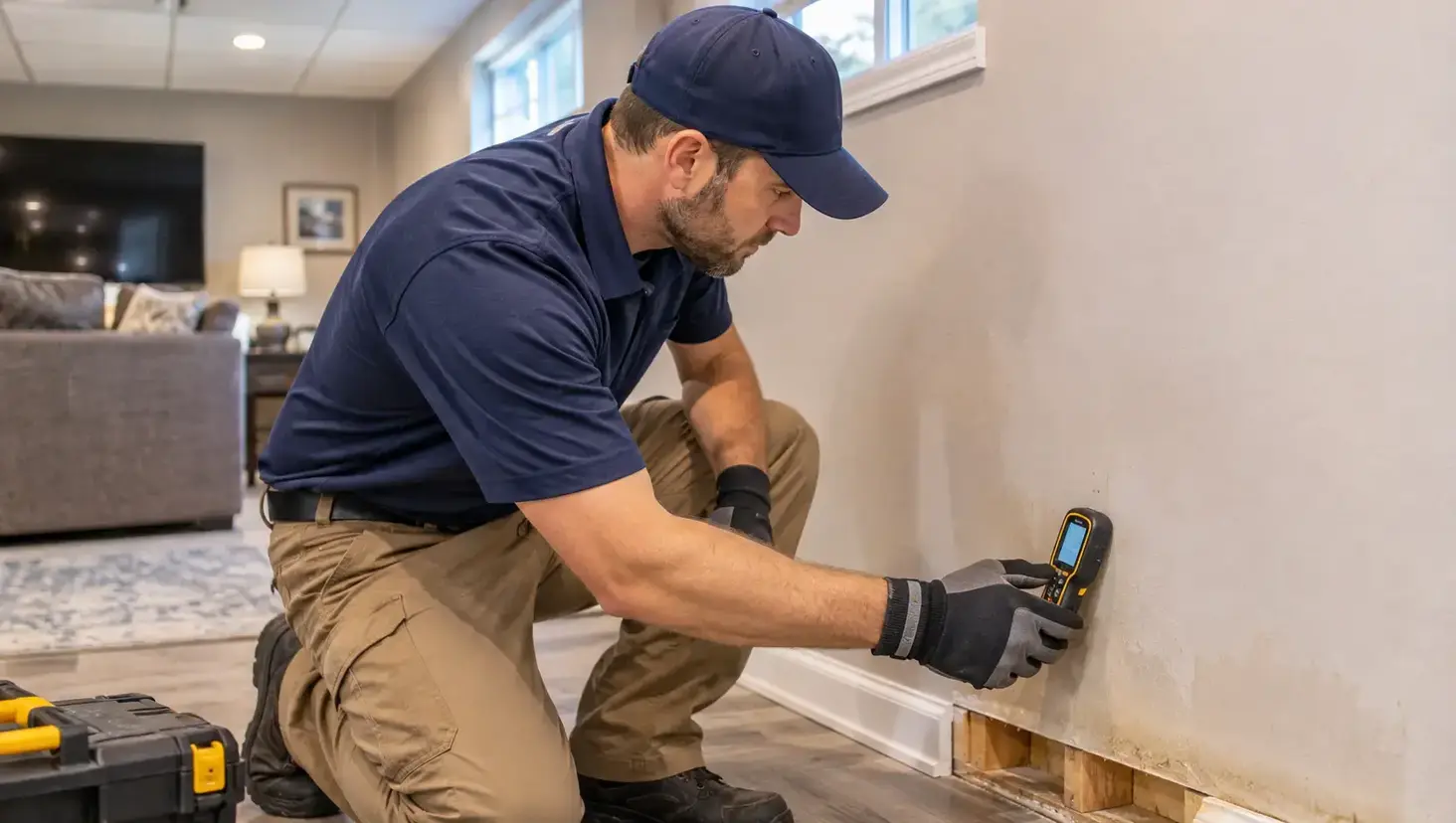
Professional water damage restoration technician assessing moisture in a water-affected Kansas City property to help reduce mold growth risk
Mold Prevention Post-Leak Moisture Control • Water Damage Assessment • Mold Growth Risk Reduction
Hidden Moisture Assessment Wall Cavities • Flooring Assemblies • Damp Building Materials
Structural Drying Moisture Removal • Dehumidification • Drying Verification
Kansas City Moisture Control Kansas City, MO • Kansas City, KS • Surrounding Communities

Mold Prevention After Water Damage in Kansas City

Mold prevention starts with understanding where water has entered a property and how far moisture has traveled into the building materials. A plumbing leak, basement flood, roof opening, appliance failure, or sump pump problem can leave water behind in places that are not immediately visible. Carpet may feel dry while its padding remains damp, a painted wall may conceal moisture inside its cavity, and water beneath flooring can remain trapped long after the visible surface has dried. These concealed conditions matter because mold can develop when moisture remains available within suitable building materials.

Kansas City homes and commercial properties have different moisture vulnerabilities depending on their construction, age, layout, and exposure to water. Finished basements can conceal seepage behind drywall and beneath carpet, while older homes may have plumbing connections and building assemblies where slow leaks go unnoticed. Ground-level properties can experience water intrusion around foundation walls, window wells, and basement floor joints. Apartment buildings and commercial spaces may also experience leaks that affect adjoining rooms, units, ceilings, and shared building areas.

Removing standing water is only one part of addressing water damage. Moisture can remain inside porous materials, beneath finished surfaces, and within enclosed building assemblies. Before deciding what needs to be dried or removed, the affected areas should be evaluated to understand the extent of moisture exposure. KC Water Damage Pros helps Kansas City property owners address these conditions through appropriate water extraction, moisture assessment, and structural drying when needed.

Depending on the source of water and the materials affected, mold-prevention work may involve several related steps:

The appropriate response depends on the source of water, how long materials were exposed, and the way the affected areas are constructed. A basement flood in a Kansas City home may require attention to carpet padding, finished walls, stored belongings, and the floor-to-wall junction. A washing machine leak may affect flooring beneath the appliance and adjoining cabinets, while a roof leak can introduce moisture into attic insulation, ceiling materials, and framing. A plumbing leak inside a wall may require investigation beyond the visible stain to determine whether water has traveled into the surrounding cavity.

Timing also matters. Mold can begin developing within approximately 24 to 48 hours under favorable moisture and environmental conditions. That does not mean every water-damaged property will develop mold within that period, but it does make prompt attention to wet materials important. Waiting for discoloration, visible growth, or a musty odor can allow an underlying moisture problem to continue unnoticed.

Mold prevention and mold remediation are not the same service. Prevention focuses on addressing moisture conditions and drying affected materials before mold growth develops. If visible mold or suspected contamination is already present, additional mold assessment and remediation may be necessary. Water extraction and structural drying alone should not be represented as removal of existing mold contamination.

For Kansas City property owners, the most important consideration is not simply whether visible water remains, but whether moisture is still present in the materials affected by the original leak or flooding. Evaluating those conditions, correcting the source of water, and determining the appropriate drying needs can help reduce the risk of mold growth and prevent a manageable water-damage incident from becoming a more extensive property problem.

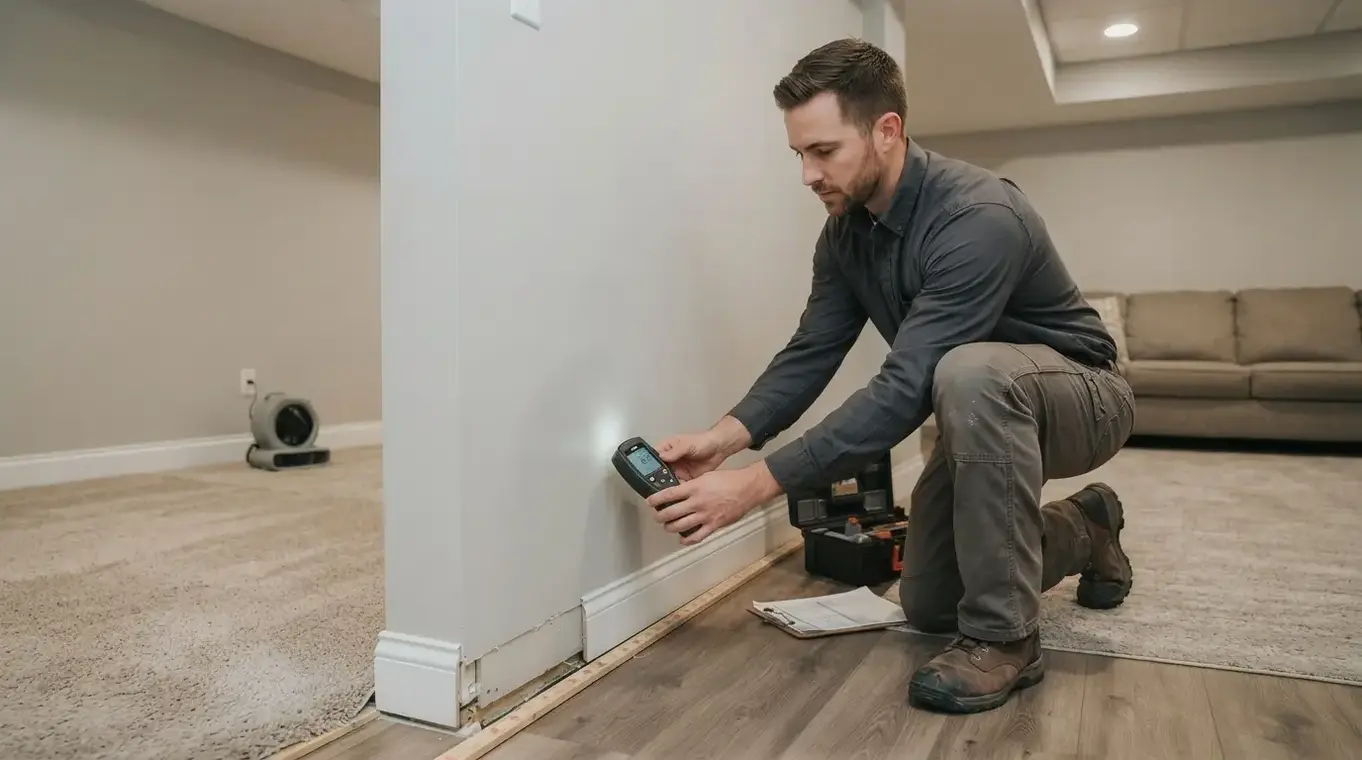
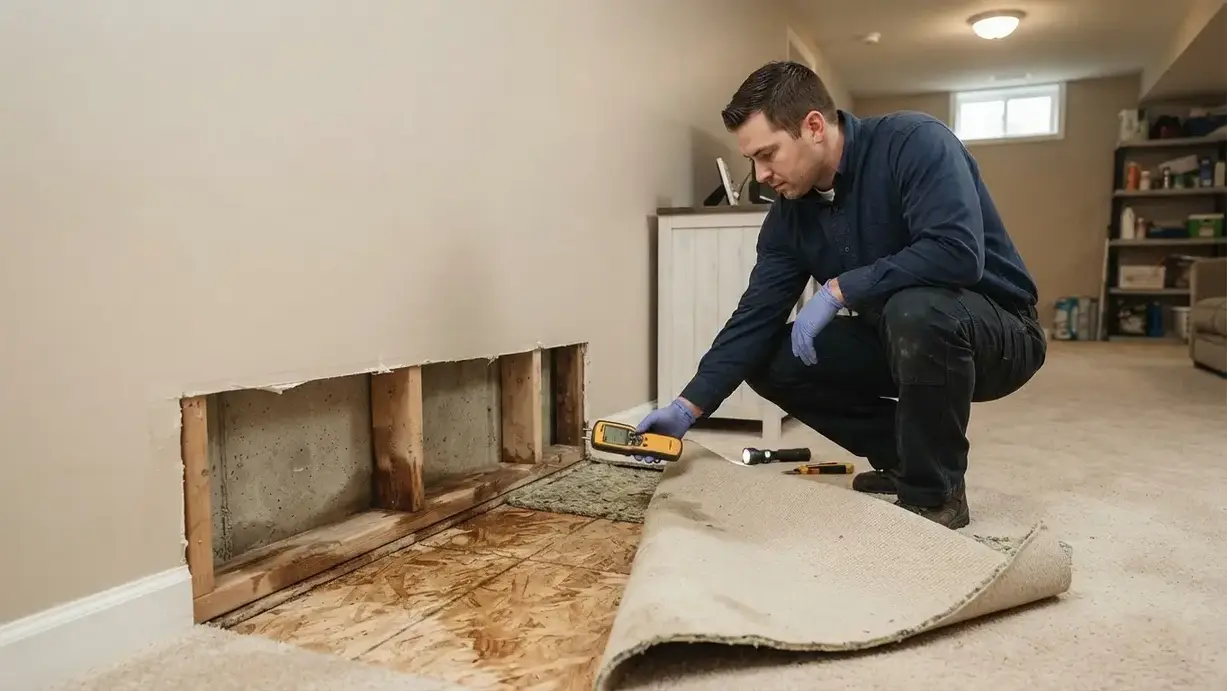
Water damage restoration technician checking a basement wall for hidden moisture with a professional moisture meter

Professional moisture assessment helps identify damp building materials and concealed moisture that may remain after visible water has been removed.

What to Do During the First 24–48 Hours After Water Damage

The first 24–48 hours after water intrusion are an important period for limiting moisture damage and reducing the conditions that support mold growth. Water does not remain only where it first enters a property. It can spread beneath flooring, wick into drywall, collect inside cabinets, and move through insulation, subflooring, and other porous building materials.

This is particularly important in Kansas City properties with finished basements, below-grade living spaces, and multi-level floor plans. A basement flood may saturate carpet padding and lower wall sections even after visible water has been removed. A second-floor plumbing leak can travel through ceiling cavities and affect insulation, framing, and the room below. The visible damage does not always reveal the full extent of moisture exposure.

The Environmental Protection Agency recommends drying wet materials within 24–48 hours when possible. This is a practical drying target, not a guarantee that mold will or will not develop at a particular time. The priority is to stop additional water from entering, address safety concerns, and begin appropriate water removal and drying as soon as conditions allow.

Immediate Steps to Take After a Water Leak or Flood

Where Hidden Moisture Can Remain After Water Extraction

Removing standing water is only one part of moisture mitigation. Water can remain trapped inside building materials after the floor surface appears clean. These concealed areas deserve particular attention following basement flooding, plumbing failures, appliance leaks, and roof or ceiling leaks.

Different Water Sources Require Different Cleanup Procedures

The source of the water is one of the most important factors in determining how affected materials should be handled. Water from a clean supply line presents different cleanup considerations from groundwater, exterior floodwater, or sewage. Water that initially appears clear should not automatically be assumed to be uncontaminated.

Kansas City Basement and Property Areas Worth Inspecting

Water intrusion in Kansas City properties can originate inside or outside the building. Plumbing failures, appliance leaks, roof drainage problems, and water entering through below-grade openings can all leave moisture in different parts of a structure. After addressing the immediate source, consider these additional inspection points:

When Professional Water Damage Evaluation Is Important

Professional moisture evaluation is worth considering when water has reached carpet padding, drywall, insulation, subflooring, cabinets, or other materials that cannot be fully inspected from the surface. It is also important when water affects multiple rooms, enters a finished basement, travels between floors, or continues to return after household cleanup.

A thorough moisture mitigation plan may include inspection of affected areas, moisture measurements, standing-water extraction, appropriate drying equipment, dehumidification, and follow-up monitoring. The exact work depends on the water source, building materials, and extent of exposure. A plumber, roofer, or drainage specialist may also be needed to correct the original source of water intrusion.

Why a Room Looking Dry Does Not Mean the Materials Are Dry

Carpet can feel dry while the padding underneath remains damp. Drywall can look normal while moisture is present behind the surface. A basement floor may no longer have standing water even though moisture remains in the subfloor, wall cavity, or materials along the perimeter. These conditions are why surface appearance and touch alone are not reliable ways to confirm that water damage has been fully addressed.

Moisture readings and follow-up inspections can help establish whether affected materials have reached appropriate drying conditions. The time required varies with the amount of water, material type, building construction, environmental conditions, and whether concealed areas are accessible. Removing drying equipment based only on a set number of days can overlook moisture that remains in less visible locations.

The most important early decision is not whether a room looks clean or dry. It is whether the water source has been controlled, potentially contaminated areas have been handled appropriately, and all affected materials have been evaluated for moisture that could contribute to future mold growth.

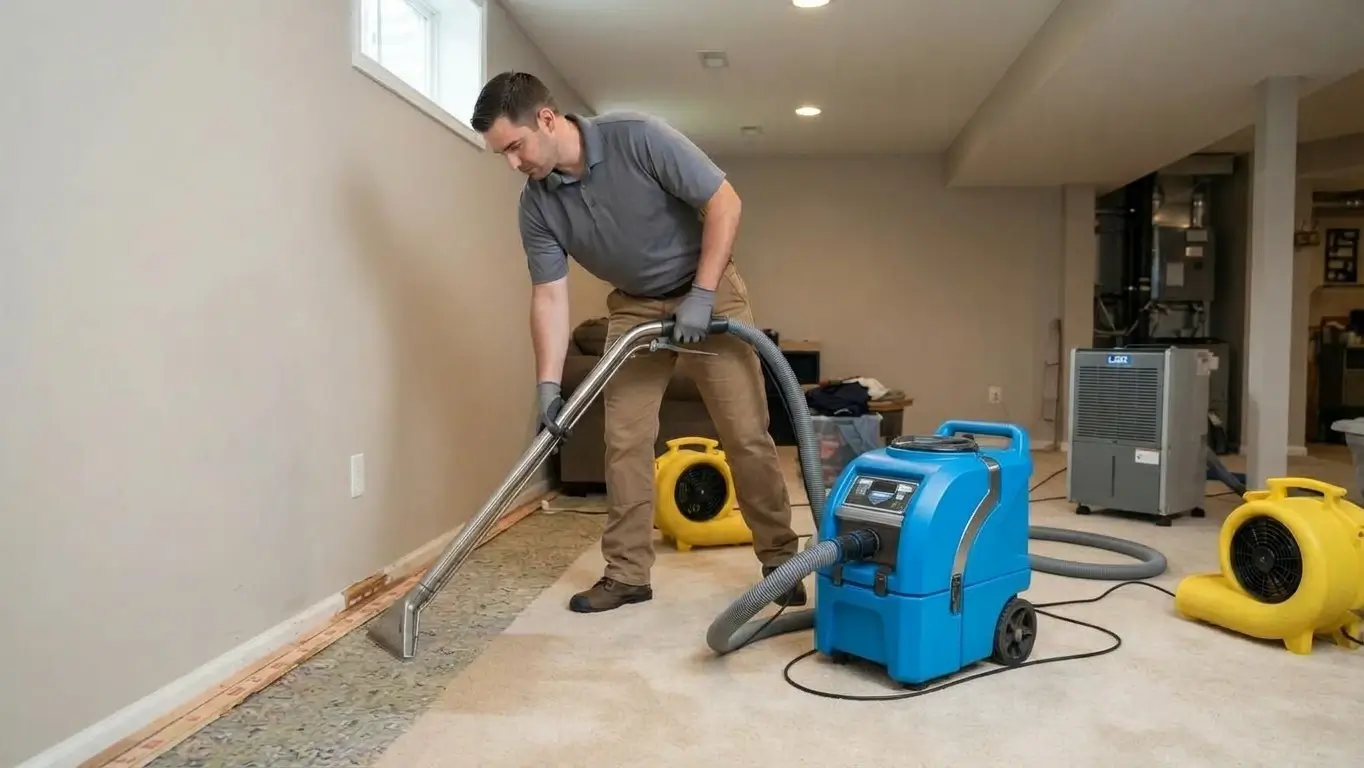
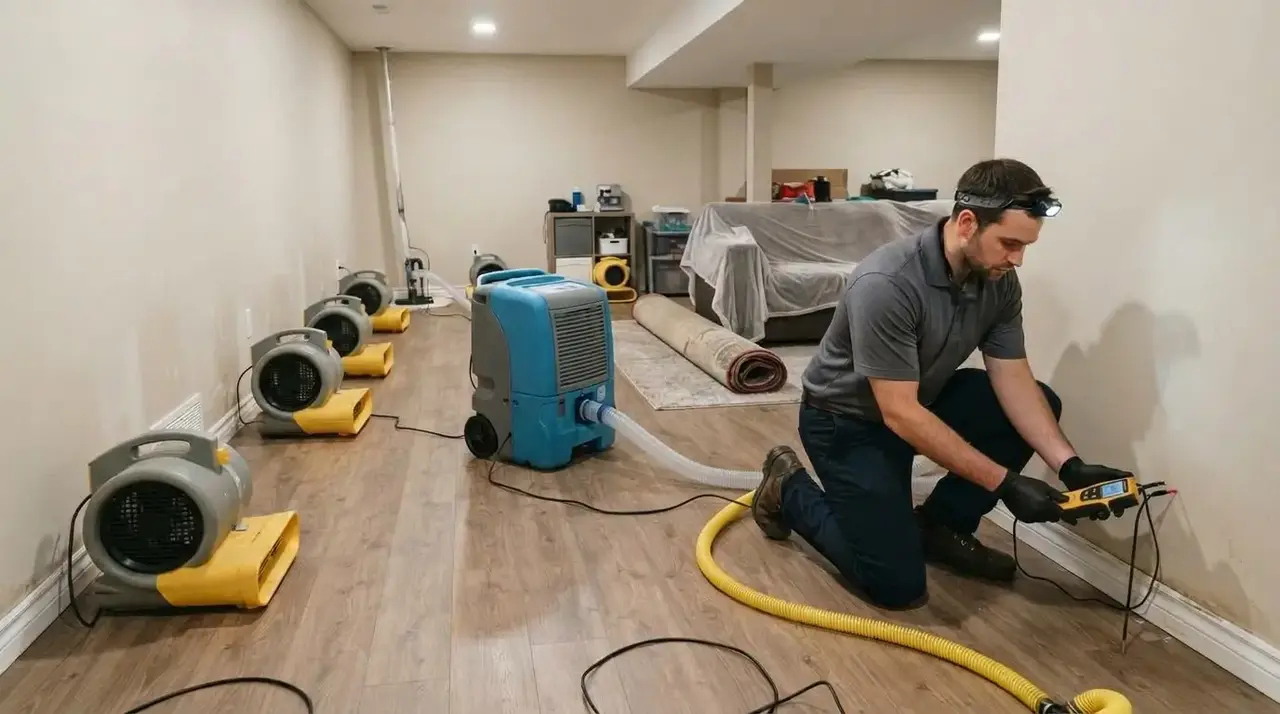
Professional water damage restoration equipment removing water and drying a finished residential basement

Water extraction removes standing water, while properly selected drying equipment helps address moisture remaining in affected building materials.

Where Hidden Moisture Develops in Kansas City Properties

Water damage in Kansas City properties does not always appear as a large puddle, visible leak, or obvious ceiling stain. Water can travel behind finished walls, beneath flooring, through insulation, and into concealed building cavities before the damage becomes noticeable. Identifying these potential moisture locations is particularly important after basement flooding, plumbing failures, appliance leaks, and roof or storm-related water intrusion.

Finished Basements and Lower-Level Rooms

Basement water intrusion can affect carpet padding, lower drywall sections, baseboards, wall cavities, and flooring assemblies. Water may spread along the wall-to-floor joint or collect beneath finished surfaces even after standing water has been extracted. Finished basement construction can make it difficult to see how far moisture has traveled.

Pay attention to carpet edges, basement closets, storage rooms, utility areas, and finished walls along exterior foundation surfaces. Moisture behind furniture and inside enclosed wall assemblies may go unnoticed during ordinary household cleanup.

Foundation Walls and Basement Window Wells

Water entering through foundation openings, basement window wells, wall penetrations, or floor joints can affect nearby insulation, drywall, trim, and flooring. A small damp area near a basement window may be the visible result of water traveling behind the finished wall or along an adjoining floor assembly.

Look for recurring dampness after rainfall, staining below basement windows, deteriorating baseboards, and moisture around utility penetrations. The source may involve exterior drainage, window-well conditions, foundation openings, or plumbing rather than a single obvious point of entry.

Kitchens, Bathrooms, and Laundry Rooms

Dishwasher connections, refrigerator supply lines, washing machine hoses, sink plumbing, toilet connections, and bathroom fixtures are potential sources of concealed water damage. Leaks can enter cabinet bases, spread beneath flooring, and affect adjoining walls before water becomes visible outside the immediate fixture area.

Inspect cabinet interiors, toe-kick spaces, flooring beside appliances, plumbing penetrations, and the areas beneath sinks and vanities. Swollen cabinet bottoms, loose flooring, soft materials, and recurring dampness can indicate moisture beneath the finished surface.

Roof Leaks, Attics, and Ceiling Cavities

Roof leaks can introduce moisture into attic insulation, roof sheathing, rafters, ceiling materials, and upper wall assemblies. Water may travel along framing or other building components before creating a visible stain. The location of a ceiling mark does not always identify the original roof opening.

After a roof leak, consider the attic or ceiling space above the visible damage, nearby insulation, framing, and adjoining walls. Repairing the roof opening is essential, but materials already exposed to water may also need inspection, drying, or removal depending on their condition.

Apartments, Condominiums, and Shared Buildings

In multi-unit properties, a plumbing failure or appliance leak in one unit can affect ceilings, walls, flooring, and adjoining spaces elsewhere in the building. Water may travel between floors or through shared walls, plumbing chases, and ceiling assemblies before the full extent of the damage becomes apparent.

Property managers should document the suspected source, affected units, common areas, and adjoining spaces that may have received water. Coordinating access to neighboring units can help identify concealed moisture and prevent an affected area from being overlooked during the restoration process.

Commercial Interiors and Utility Areas

Commercial water damage can affect suspended ceilings, office partitions, storage areas, mechanical rooms, floor coverings, and inventory stored directly on the floor. A leak above ceiling tiles may spread across several sections before dripping becomes noticeable. Water can also enter wall cavities and concealed spaces around utility connections.

Businesses should consider the areas above affected ceiling tiles, nearby electrical equipment, stored materials, mechanical spaces, and adjoining rooms. The assessment should account for building access, equipment safety, and whether moisture has reached areas beyond the initial leak location.

Kansas City Exterior Moisture Conditions Worth Checking

When basement moisture appears after rainfall, the exterior conditions around the affected wall can provide useful clues about possible water entry. Check whether gutters are carrying roof runoff properly, whether downspouts discharge away from the foundation, and whether the surrounding ground directs water toward the building. Basement window wells, foundation penetrations, and low areas beside the structure may also deserve attention.

These conditions do not establish the exact cause of a leak, but they can help identify potential pathways that deserve further investigation. Recurring basement water intrusion may require gutter improvements, grading corrections, foundation drainage work, or repairs to an entry point in addition to interior water extraction and structural drying. Drying the inside of a property does not permanently correct an exterior water-entry problem that continues to occur.

Why hidden moisture matters: Water extraction removes standing water, but it does not automatically remove moisture trapped beneath flooring, behind baseboards, inside cabinets, or within wall and ceiling cavities. These areas may require additional inspection and moisture measurements to determine whether drying or material removal is necessary.

The appropriate response depends on the source of water, the materials affected, and how long they have remained wet. Sewage and potentially contaminated floodwater require additional precautions and should not be treated as ordinary clean-water leaks.

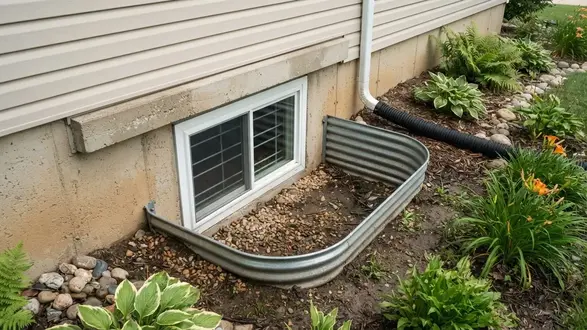
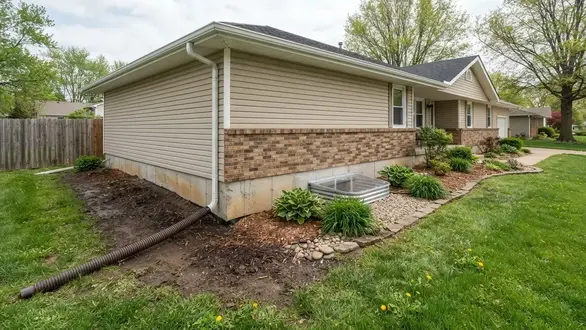
Residential basement window well and foundation area where exterior water intrusion can affect interior building materials

Basement window wells, foundation openings, and nearby drainage conditions are important areas to inspect when water intrusion affects lower-level rooms.

Concerned About Hidden Moisture in Your Kansas City Property?

If a basement leak, plumbing failure, roof leak, or flooding event has left materials damp, visible cleanup may not reveal the full extent of the moisture. Water can remain beneath flooring, behind baseboards, inside cabinets, and within finished wall or ceiling assemblies. Identifying these affected areas can help determine whether additional moisture assessment, water extraction, or structural drying is needed. KC Water Damage Pros connects Kansas City property owners with water damage restoration assistance for visible and concealed moisture concerns. Call to discuss where the water entered, which materials were affected, and what areas may need further evaluation.

Call (816) 370-6439

Can Water-Damaged Building Materials Be Dried or Do They Need Removal?

Not every water-damaged building material needs to be replaced. Some materials can be cleaned and dried in place, while others may need removal because they absorbed too much moisture, lost their structural integrity, or cannot be adequately cleaned after exposure to contaminated water.

The decision depends on the water source, how long materials remained wet, how deeply moisture penetrated, the material's condition, and whether the affected surfaces and concealed spaces can be accessed and dried. A clean supply-line leak presents different restoration considerations from a sewage backup or exterior floodwater intrusion.

Carpet & Carpet Padding

Carpet may sometimes be salvageable after a clean-water incident when it can be lifted, cleaned as appropriate, and thoroughly dried. The carpet padding underneath often presents a separate problem because it can hold substantial moisture against the floor.

Saturated padding may need removal, particularly when it cannot be adequately dried or has been exposed to contaminated water. The subfloor must also be checked. Carpet that feels dry on top does not establish that the backing, padding, or flooring beneath it is dry.

Drywall & Interior Wall Assemblies

Drywall exposed to a limited clean-water leak may sometimes be dried in place if it remains structurally sound and moisture can be removed from the affected assembly. However, water can travel behind the visible surface and reach insulation, framing, and the back of the wallboard.

Removal may be necessary when drywall is swollen, deteriorated, heavily saturated, or contaminated. Wall cavities should be evaluated before they are closed again so trapped moisture is not concealed behind replacement drywall.

Fiberglass & Cellulose Insulation

Insulation inside walls, ceilings, and attic spaces can be difficult to dry because it is often enclosed between other building materials. Fiberglass can retain moisture and may become compressed or contaminated. Cellulose is particularly absorbent and can hold substantial water after saturation.

Removal and replacement may be appropriate when insulation is saturated, contaminated, damaged, or cannot be thoroughly dried in place. The surrounding framing and wall or ceiling cavity should be evaluated as part of that decision.

Hardwood, Laminate & Subflooring

Hardwood can absorb moisture and develop cupping, buckling, staining, or separation between boards. Laminate flooring may swell at its edges and joints. Moisture can also become trapped between finished flooring and the subfloor, particularly after a basement or plumbing leak.

Some wood flooring assemblies may be candidates for controlled drying, depending on the extent of damage and construction. Severely swollen or deteriorated materials may require removal. The subfloor must be checked before replacement flooring is installed.

Furniture & Personal Belongings

Upholstered furniture, cushions, mattresses, cardboard boxes, stored clothing, and other belongings can absorb water during a basement flood or plumbing failure. Some washable fabrics and suitable household items may be cleaned and dried, while others may be difficult to restore.

Sewage and contaminated floodwater require additional precautions. Mattresses, upholstered items, and other deeply absorbent belongings may not be suitable for restoration after contaminated exposure. Valuable or irreplaceable possessions may warrant evaluation by a specialized contents-restoration provider.

Ceiling Tiles & Ceiling Insulation

Suspended ceiling tiles and ceiling insulation can absorb water from roof leaks, plumbing failures, or leaks originating on an upper floor. Stained, sagging, swollen, or deteriorated tiles may need replacement rather than being returned to service.

The concealed space above the ceiling also needs attention. Water may have reached insulation, framing, electrical components, or other building materials that cannot be evaluated from the occupied room alone.

Concrete & Foundation Masonry

Concrete basement floors, foundation walls, and masonry surfaces may remain damp after visible standing water has been removed. Moisture can move into porous concrete and masonry, collect in cracks and joints, or remain beneath flooring and finished wall systems.

These materials do not automatically require demolition. They generally need appropriate cleaning, drying, and moisture evaluation. Flooring and wall finishes should not be reinstalled until the underlying surfaces are sufficiently dry for the planned installation.

Cabinets, Vanities & Built-In Storage

Kitchen cabinets, bathroom vanities, and built-in storage can conceal water from plumbing leaks, appliance failures, and overflowing fixtures. Moisture may collect beneath cabinet bases, behind toe kicks, along wall connections, and inside enclosed compartments.

Solid components may be candidates for cleaning and drying if they remain sound. Swollen particleboard, deteriorated cabinet bases, and water-damaged composite materials may require replacement. Concealed areas should be checked before cabinets are considered dry.

Why the Source of Water Changes the Restoration Decision

Water from a broken supply line is not equivalent to water from a sewage backup, overflowing drain, or exterior flood. Water that initially appears relatively clean may also pick up contaminants after contacting soil, waste, building debris, or other affected surfaces.

Materials exposed to contaminated water require particular care. Porous materials such as drywall, carpet padding, insulation, and upholstered furnishings can be difficult to clean thoroughly because contaminants may penetrate beyond the accessible surface. Removal may be necessary when adequate cleaning and restoration are not practical.

Why Moisture Assessment Matters Before Rebuilding

Removing damaged materials unnecessarily can increase demolition and replacement costs. However, leaving saturated, deteriorated, or contaminated materials in place can conceal moisture and create problems after repairs are completed. The goal is to identify what can reasonably be restored and what needs to be removed.

Before new drywall, flooring, insulation, or cabinetry is installed, affected materials should be evaluated for remaining moisture. Moisture meters and other appropriate inspection methods can help identify damp areas that are not obvious from appearance alone. Concrete, subfloors, wall cavities, and other concealed areas may need additional drying time.

Important: Drying and moisture mitigation do not automatically make contaminated materials safe to reuse, nor do they remove existing mold contamination. Material removal, cleaning, and any necessary remediation should be determined by the water source, material condition, and extent of contamination.

Water-damaged basement drywall and carpet removed to expose damp building materials for inspection

Water damage can affect more than visible surfaces. Carpet padding, drywall, insulation, and subflooring may need separate evaluation before restoration decisions are made.

What Happens During Professional Moisture Mitigation and Structural Drying?

Professional moisture mitigation involves identifying where water has traveled, removing excess moisture, and determining whether affected building materials can be dried or need to be removed. After a burst pipe, basement flood, roof leak, appliance failure, or recurring plumbing problem, moisture may remain inside wall cavities, beneath flooring, and within structural materials long after visible water is gone. For Kansas City property owners, a thorough mitigation process helps address these hidden conditions before they contribute to material deterioration, persistent moisture problems, or mold growth.

1. Identify the Water Source and Stop Further Intrusion

The first priority is determining where the moisture originated and whether water is still entering the property. Common situations include leaking supply lines, failed appliance connections, water heaters, roof leaks, foundation seepage, sump pump failures, and basement flooding. Identifying the source helps determine what needs to happen before drying can be effective.

Active plumbing leaks may require a plumber, while roof, drainage, foundation, or exterior water intrusion may require a separate repair. Moisture mitigation addresses the resulting water damage, but stopping the original source is essential to preventing continued exposure and recurring problems.

2. Inspect Affected Areas and Determine Water Conditions

The affected rooms and adjoining spaces are evaluated to understand the extent of the moisture problem. This may include inspecting drywall, baseboards, flooring, insulation, cabinets, ceilings, and areas around plumbing fixtures. Water can travel beyond the original leak location, so the visible damage does not always show the full area requiring attention.

The source and condition of the water also influence the appropriate response. A limited supply-line leak may present different cleanup requirements from a sewage backup, drain overflow, or contaminated floodwater. Water exposure conditions can change over time, making the history and condition of the affected materials important parts of the assessment.

3. Detect Hidden Moisture and Map Affected Materials

Moisture can remain concealed beneath carpet, behind baseboards, inside wall cavities, under flooring, and around lower sections of cabinets. Moisture meters and other appropriate inspection tools help identify materials that may need additional drying or closer evaluation. This is especially important when a leak has continued unnoticed or water has affected multiple rooms.

Infrared cameras may help identify temperature patterns associated with possible moisture intrusion, but those findings need confirmation with suitable inspection methods. Mapping affected locations helps guide extraction, equipment placement, material decisions, and follow-up monitoring rather than relying only on visible staining or how a surface feels.

4. Remove Standing Water and Evaluate Damaged Materials

When standing water is present, appropriate extraction equipment may be used to remove water from affected floors, carpets, and other accessible surfaces. Removing excess water reduces continued exposure and prepares the area for the next stages of mitigation. Extraction alone, however, does not remove moisture that has already entered porous or concealed building materials.

Materials are then evaluated to determine whether they can be cleaned and dried or need removal. Carpet padding, saturated insulation, swollen flooring, damaged drywall, and other porous materials may require different decisions depending on their condition, exposure duration, and the source of the water. Contaminated materials require appropriate handling and should not be treated like an ordinary clean-water leak.

5. Establish Controlled Structural Drying Conditions

After extraction and necessary material removal, air movers and commercial dehumidifiers may be positioned to support the drying of affected building materials. The equipment arrangement depends on the size of the affected area, material types, moisture conditions, and how air can circulate through the space. Different properties may require different drying approaches.

Kansas City homes with finished basements, below-grade rooms, enclosed utility spaces, and wall assemblies can present additional drying challenges. Moisture may remain near foundation walls, beneath flooring, around window wells, or in areas with limited airflow. Equipment placement should account for these conditions rather than treating every wet room the same way.

6. Monitor Drying Progress and Verify Results

Structural drying requires follow-up inspections rather than simply running equipment for a predetermined number of days. Moisture readings, material conditions, temperature, and indoor humidity help indicate whether drying is progressing as expected. Equipment may need to be adjusted when readings show that certain areas are drying more slowly than others.

Drying goals should be based on appropriate measurements and the condition of the affected materials. Once mitigation requirements have been addressed, remaining work can be evaluated. Depending on the damage, this may include replacing drywall or insulation, repairing flooring, reinstalling trim, repainting, or coordinating additional reconstruction. Plumbing, roofing, drainage, or foundation repairs may also be necessary to prevent the original moisture problem from returning.

Proper Moisture Mitigation Goes Beyond Making a Room Look Dry

Visible water removal is only one part of moisture mitigation. A basement floor may look dry while moisture remains beneath finished flooring, behind baseboards, or inside lower wall sections. A plumbing leak may also affect adjoining rooms or materials below the original source. Identifying these conditions helps property owners understand why moisture detection, material evaluation, and follow-up drying measurements are important parts of the process.

Kansas City properties can have different moisture challenges depending on their layout, age, construction, and exposure. Finished basements, sump pump areas, window wells, utility rooms, shared plumbing systems, and roof or appliance leaks can all require different inspection and drying considerations. The appropriate response depends on the actual conditions found at the property, not simply the amount of visible water.

It is also important to understand the difference between water extraction, moisture mitigation, structural drying, mold remediation, and reconstruction. These are related but distinct services. Mitigation and drying address water-related conditions, while established mold growth, plumbing defects, roof failures, and structural repairs may require additional specialized work. A clear assessment helps determine which steps are necessary and what remains outside the scope of the initial mitigation.

Whether the problem involves a flooded basement in Kansas City, a burst pipe in Independence, a recurring leak in Lee's Summit, or water intrusion at a commercial property elsewhere in the metro, understanding the source, affected materials, and drying progress helps guide a more complete recovery.

Commercial air movers and dehumidifier positioned inside a water-damaged Kansas City basement during structural drying

Professional structural drying uses appropriately positioned air movers and dehumidifiers, with follow-up moisture measurements to evaluate drying progress.

Indoor Humidity and Condensation Control After Water Damage

Drying water-damaged materials is only part of preventing future moisture problems. Indoor humidity, condensation, limited air circulation, and recurring dampness can continue creating conditions favorable to mold growth even after the original leak has been repaired. Kansas City property owners should consider both the moisture that entered the building and the indoor conditions that can allow moisture to accumulate again.

What Indoor Humidity Level Helps Reduce Mold Risk?

The U.S. Environmental Protection Agency recommends keeping indoor relative humidity below 60%, ideally between 30% and 50% when practical. A digital hygrometer can help homeowners monitor humidity in basements, bedrooms, bathrooms, laundry rooms, and other areas where moisture tends to accumulate. A single reading does not establish whether a building material is dry, but repeated readings can reveal whether indoor humidity is consistently elevated.

A home can have acceptable humidity in its main living area while a basement, utility room, or enclosed storage space remains damp. For that reason, monitor rooms that previously experienced water damage separately rather than relying on one thermostat or humidity reading for the entire property.

Monitor Basement Humidity

Finished basements can retain moisture because they are below grade and may have limited natural air circulation. Place a hygrometer in the basement living area and consider checking separate storage rooms, utility spaces, and areas near previously affected walls.

If readings remain elevated, investigate possible sources such as plumbing leaks, foundation seepage, inadequate ventilation, or moisture entering from outside. A dehumidifier can help manage indoor humidity, but it does not repair a water-entry problem or dry concealed materials automatically.

Watch for Window and Wall Condensation

Condensation develops when humid indoor air contacts a surface that is cool enough for water vapor to condense. Windows, exterior wall surfaces, pipes, and poorly insulated areas can become condensation locations during colder weather.

Repeated moisture on window frames, wall corners, or other cool surfaces should not be dismissed as ordinary dampness. Check indoor humidity, ventilation, insulation conditions, and possible air leaks to understand why condensation keeps returning.

Use Bathroom and Kitchen Exhaust Fans

Bathrooms, kitchens, and laundry areas introduce moisture into indoor air through showers, cooking, dishwashing, and drying activities. Exhaust fans that discharge outdoors can help remove moisture before it spreads into adjoining rooms.

Check that fans operate properly and that their exhaust is directed outdoors rather than into an attic, wall cavity, or other enclosed space. Persistent condensation after showers or cooking may indicate that ventilation needs attention.

Manage Dehumidifier Operation

A properly sized dehumidifier may help maintain suitable humidity in a basement or other damp indoor area. Select a unit appropriate for the space and follow the manufacturer's instructions for drainage, filter cleaning, and operating conditions.

Check the collection bucket or drainage connection regularly. A full bucket, blocked drain hose, or failed unit can interrupt moisture control without being immediately obvious. Dehumidification should complement source repairs and structural drying, not replace them.

Why a Dehumidifier Cannot Fix Every Moisture Problem

A dehumidifier removes moisture from indoor air. It does not repair a leaking foundation, stop a plumbing leak, correct a roof opening, or remove water trapped beneath flooring and inside wall cavities. A room may show a lower relative humidity while concealed building materials remain wet.

If a basement continues to smell damp, flooring remains swollen, or moisture readings remain elevated after a water incident, the affected materials and original water source may need further evaluation. Lowering the humidity in the room does not establish that the entire water-damage problem has been resolved.

Keep Moisture Under Control After the Drying Equipment Is Removed

Once water mitigation is complete, continue monitoring rooms that experienced water damage. Check basement humidity, watch for recurring condensation, and investigate dampness around previously affected flooring, walls, cabinets, and plumbing fixtures.

The goal is to address both sides of the problem: remove moisture that entered the building and reduce the indoor conditions that allow moisture to accumulate again. If dampness returns, investigate the source instead of relying on a dehumidifier to manage the symptoms indefinitely.

HVAC Systems and Air Ducts After Water Damage

Heating and cooling systems can become part of a moisture problem when water reaches HVAC equipment, ductwork, insulation, air handlers, or surrounding building cavities. A basement flood, ceiling leak, plumbing failure, or roof opening may affect mechanical areas even when the main HVAC equipment appears undamaged. Before returning a water-affected system to normal operation, property owners should consider whether water or contamination reached any part of the equipment or air distribution system.

How Water Damage Can Affect Heating and Cooling Equipment

HVAC systems contain electrical components, filters, condensate drainage systems, insulation, and air handling equipment. Water exposure can damage components or create conditions that require inspection before operation. The appropriate response depends on where water entered and which parts of the system were affected.

Basement Furnaces and Air Handlers

Furnaces, air handlers, and related equipment installed in basements or utility rooms may be exposed during flooding or plumbing failures. Water can affect electrical components, insulation, controls, and equipment connections.

If floodwater reached the equipment or its electrical components, do not assume the system is safe to operate once the water is removed. Have it evaluated by a qualified HVAC professional before restarting it.

Ductwork and Return-Air Openings

Ductwork located near flooded floors, damaged ceilings, or water-affected wall cavities may require inspection. Water, debris, or contamination entering ducts can create concerns beyond the room where the original leak occurred.

Return-air grilles and nearby duct openings should be considered when water or visible contamination is present in the surrounding area. Whether cleaning or other corrective work is necessary depends on the actual condition of the system.

HVAC Filters and Moisture Exposure

Filters exposed directly to water or contaminated debris may need replacement. A wet or damaged filter should not simply be returned to service. Check the filter compartment and surrounding equipment for evidence of water intrusion.

Replacing a filter does not resolve contamination inside the equipment or ductwork. If water entered the system, the affected components should be evaluated separately.

Condensate Drainage and HVAC Moisture

Air-conditioning systems remove moisture from indoor air and discharge condensate through a drainage system. A clogged drain, damaged condensate line, or overflowing drain pan can introduce water around the air handler or nearby building materials.

Recurring water near HVAC equipment should be investigated to identify whether the source is condensate drainage, another plumbing connection, or a separate water intrusion problem.

Should You Run the HVAC System After a Basement Flood?

Do not operate HVAC equipment that may have been affected by floodwater or contaminated water until it has been appropriately evaluated. The U.S. Environmental Protection Agency advises against operating a flood-affected HVAC system because doing so can spread contamination. Electrical safety and the condition of the equipment also need to be considered.

If the HVAC system was not exposed to water, that does not automatically mean every component is unaffected. A leak above a ceiling, for example, may reach duct insulation, air distribution components, or nearby electrical equipment. The affected areas should be identified before assuming the system can return to normal operation.

When to Involve an HVAC Professional

Important distinction: Water damage restoration and HVAC servicing are related but separate scopes of work. A water mitigation provider may evaluate surrounding building materials and address moisture damage, while an HVAC professional may be needed to inspect, repair, or clean affected heating and cooling equipment.

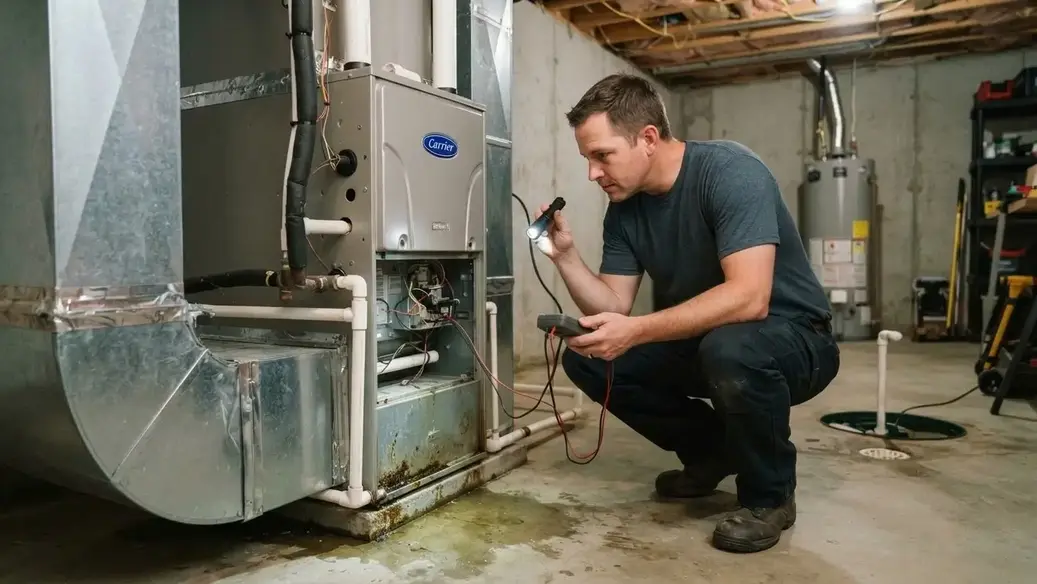
HVAC technician inspecting basement heating and cooling equipment after water damage

Water intrusion near furnaces, air handlers, ductwork, and electrical components may require an HVAC inspection before affected equipment is returned to operation.

Need Help With Water Damage Around Your HVAC System?

If basement flooding, a plumbing leak, or a ceiling leak has affected the area around your furnace, air handler, ductwork, or mechanical room, it is important to identify which building materials and equipment may have been exposed. Wet insulation, drywall, flooring, and surrounding structural materials may require additional moisture assessment and drying. HVAC equipment that may have contacted floodwater should be evaluated by a qualified HVAC professional before being operated. KC Water Damage Pros connects Kansas City property owners with water damage restoration assistance for affected interiors and moisture concerns around mechanical areas. Call to discuss the water intrusion and which areas may need further evaluation.

Call (816) 370-6439

How to Prevent Recurring Basement Moisture in Kansas City Homes

A basement that has flooded or developed recurring dampness needs more than interior water removal. The original moisture source must be identified and addressed to reduce the chance of another incident. In Kansas City, basement moisture concerns can involve plumbing failures, sump pump problems, window wells, roof runoff, foundation openings, and exterior drainage conditions. The right prevention measures depend on where water enters and how it reaches the affected part of the property.

Keep Gutters and Downspouts Clear

Gutters collect roof runoff and direct it toward downspouts. When gutters become clogged or downspouts discharge too close to the foundation, water can accumulate beside the building and contribute to basement moisture problems.

Check gutters for debris, inspect downspout connections, and make sure discharge is directed away from the foundation in accordance with local requirements and site conditions. Look for disconnected extensions, leaking joints, and areas where runoff repeatedly collects.

Check Ground Slope Around the Foundation

Ground that slopes toward a house can direct surface water toward foundation walls instead of away from them. Low areas beside the building may collect runoff and contribute to recurring moisture near basement walls.

Inspect the ground around the affected side of the property after rainfall. Persistent pooling, erosion, or settlement may indicate that grading or drainage improvements deserve attention from a qualified professional.

Maintain Basement Window Wells

Window wells can collect leaves, soil, and runoff. If drainage is obstructed or the window assembly is damaged, water may enter around the basement window and affect nearby drywall, trim, and flooring.

Keep window wells clear, inspect covers and visible drainage components, and investigate recurring water stains beneath basement windows. A repeated leak may require window-well drainage or foundation-related repairs.

Test Sump Pump Operation

A sump pump helps remove collected water from a sump basin. A failed pump, blocked discharge line, stuck float switch, or power interruption can leave a basement vulnerable when water enters the basin.

Follow the manufacturer's testing instructions and inspect the discharge route for visible obstructions. Property owners may also consider discussing backup power or backup pump options with a qualified installer. A working pump does not eliminate every possible source of basement water intrusion.

Inspect Plumbing and Appliance Connections

Supply lines, drain connections, water heaters, washing machines, dishwashers, and refrigerator water lines can cause leaks that remain concealed for extended periods. Small leaks may affect cabinet bases, flooring, nearby walls, and materials beneath appliances.

Periodically inspect accessible plumbing connections and look for corrosion, dripping, staining, swollen cabinet materials, or unexplained dampness. Replace deteriorated hoses and arrange repairs when a connection shows signs of failure.

Control Basement Humidity

Even without an active leak, elevated indoor humidity and condensation can contribute to damp basement conditions. Monitor relative humidity, use suitable dehumidification when needed, and investigate repeated condensation on cool surfaces.

A dehumidifier can help manage indoor humidity, but it cannot correct water entering through a foundation opening, leaking plumbing, or defective exterior drainage. Persistent dampness deserves investigation rather than indefinite reliance on equipment.

What to Check After Heavy Rainfall

If a Kansas City basement has experienced water intrusion, inspect the property after subsequent rainfall when conditions are safe. Look for new damp spots near foundation walls, water collecting in window wells, overflowing gutters, disconnected downspouts, and areas where runoff moves toward the house. Compare these observations with the locations affected during the original incident.

If water repeatedly appears in the same basement corner, along the same wall, or near the same window, document the location and timing. A recurring pattern can help a qualified drainage or foundation professional investigate the likely entry pathway. Interior drying may restore affected materials, but recurring exterior water intrusion needs its own corrective plan.

When Basement Moisture Requires More Than Routine Maintenance

Repeated water entry, persistent dampness, foundation cracking, ongoing seepage, and recurring flooding should not be treated as ordinary humidity problems. Depending on the cause, the property may need plumbing repairs, foundation evaluation, drainage improvements, sump system service, or other specialized work.

Prevent the Next Water Problem, Not Just the Last One

Water extraction and structural drying address the moisture already inside the property. Long-term prevention requires identifying why the water entered and correcting conditions that could allow another incident.

For a Kansas City home with a finished basement, that may mean coordinating interior mitigation with exterior drainage corrections, sump pump service, plumbing repairs, or window-well improvements. The appropriate work depends on the actual source of the water rather than a one-size-fits-all basement waterproofing recommendation.

Residential foundation drainage inspection showing basement window well, downspout extension, and ground grading

Exterior drainage conditions around gutters, downspouts, window wells, and foundation walls can help explain recurring basement water intrusion.

Warning Signs of Mold After Water Damage in Kansas City

Water damage can leave moisture trapped behind walls, beneath flooring, inside insulation, and within other building materials long after visible water has been removed. When affected materials remain damp, conditions may develop that support mold growth. Kansas City properties with finished basements, older plumbing, foundation moisture issues, and previous leaks may have concealed areas that need additional evaluation. Recognizing warning signs can help property owners determine whether moisture mitigation is sufficient or existing mold growth may require separate attention.

Common Warning Signs of Mold or Lingering Moisture

Mold Prevention vs. Mold Remediation: Which Service Is Needed?

Mold prevention focuses on correcting moisture conditions and drying affected materials to reduce the likelihood of mold growth. It is appropriate when water damage has occurred and no visible or suspected mold growth has been identified. The work typically involves addressing the water source, removing excess water, evaluating affected materials, and completing appropriate drying. The absence of visible growth does not rule out concealed mold.

Mold remediation addresses existing mold contamination. Depending on the affected materials and extent of growth, remediation may involve containment, removal of affected materials, appropriate cleaning, and correction of the moisture source. Water extraction and structural drying may be part of the broader recovery, but they do not substitute for mold remediation when established contamination is present.

Should You Paint Over a Water Stain or Suspected Mold?

Painting over a water stain does not establish that the material underneath is dry or that the source of water has been corrected. Likewise, paint, primer, and surface coatings should not be used to conceal suspected mold growth without addressing the underlying condition.

Before repainting or installing new finishes, determine whether the water source has been repaired, affected materials have been appropriately evaluated, and any necessary cleaning, removal, remediation, and drying have been completed. Covering a damaged surface too early can make later inspection more difficult and leave concealed moisture or contamination unaddressed.

When to Arrange a Separate Mold Assessment or Remediation

Consider evaluation by a qualified mold assessment or remediation professional when visible growth is present, contamination may extend into concealed materials, or a recurring moisture problem has affected a substantial area. Larger affected areas, contaminated water exposure, and potentially affected HVAC systems may require additional specialized evaluation.

Not every water-damaged property requires mold testing or a separate remediation project. The appropriate response depends on the visible conditions, moisture history, affected materials, and whether existing contamination is suspected.

If water damage is still affecting your property, professional water extraction can help remove standing water, while structural drying addresses moisture in affected building materials. When mold growth is already present, drying alone is not a substitute for appropriate remediation.

Signs Your Kansas City Property May Need Structural Drying

Water damage is not always limited to the surfaces where water is visible. After a plumbing leak, appliance failure, roof intrusion, or basement water event, moisture can remain inside drywall, beneath flooring, behind baseboards, and within other building materials. Recognizing these warning signs can help determine when a professional moisture assessment is needed.

A room may appear clean and dry after standing water has been removed while moisture remains trapped in concealed areas. Changes in flooring, wall finishes, trim, and indoor conditions can provide clues that the drying process is not complete.

Damp or Discolored Baseboards

Baseboards can absorb water from wet flooring or moisture moving through the lower portion of a wall. Swelling, discoloration, loose trim, peeling paint, or a damp feel near the floor may indicate that moisture has extended beyond the visible damage.

Water can also move behind baseboards and into the bottom portion of drywall. If a plumbing leak or floor-level water intrusion affected the room, the wall and the materials behind the trim may need to be evaluated.

Flooring That Feels Different

Buckling, raised edges, soft spots, lifting seams, and changes in the way flooring feels underfoot can indicate moisture beneath the finished surface. Hardwood may cup or swell, laminate can separate at its joints, and carpet may conceal damp padding underneath.

The subfloor can remain wet even when the flooring surface feels relatively dry. Moisture measurements may be needed to determine whether water has reached the underlying floor assembly and whether additional drying or material removal is appropriate.

Water Stains on Ceilings or Walls

A ceiling stain, bubbling paint, or discolored drywall may be the visible portion of a larger moisture problem. Water from an upper-floor plumbing leak or roof intrusion can travel along framing and collect inside ceiling and wall cavities.

Insulation, framing, and adjoining rooms may also be affected. The location of a stain does not necessarily identify where the water traveled, so the surrounding building materials may need to be checked before repairs begin.

Persistent Indoor Dampness

A room that continues to feel damp after a leak has been repaired may have moisture remaining in porous building materials. Persistent damp conditions can occur when drywall, flooring, insulation, or concealed spaces have not dried adequately.

A musty odor can also be a reason to investigate, particularly after a water intrusion event. However, odor alone cannot confirm the location or extent of moisture. An assessment can help identify whether affected materials need additional drying.

Previous Basement Flooding

Kansas City area basements can be affected by plumbing failures, sump pump problems, foundation seepage, and heavy rainfall. Water may reach carpet, padding, finished walls, framing, stored belongings, and floor assemblies.

Even after visible water is extracted, moisture may remain beneath flooring, behind finished walls, and around lower wall sections. Basement drying should account for both the visible damage and the building materials that were exposed to water.

A Leak That Went Undetected

Slow supply-line leaks, plumbing connection failures, refrigerator lines, and appliance leaks can allow water to spread before anyone notices. Cabinets, flooring, subfloors, wall cavities, and nearby building materials may be affected.

The longer materials remain exposed to water, the more important it becomes to identify the full extent of the affected area. Repairing the plumbing stops the source, but it does not remove moisture that has already entered the structure.

When Should You Arrange a Structural Drying Assessment?

Consider a moisture assessment when building materials remain damp, flooring has changed shape, stains continue to spread, or a leak affected more than the immediately visible surface. An assessment can help identify which materials need additional drying and whether concealed areas should be investigated.

This is especially important after basement flooding, an undetected plumbing leak, or water that traveled between floors. Do not assume a room is dry simply because standing water has been removed or the exposed surfaces feel dry. Moisture readings provide a more reliable way to evaluate affected materials.

Questions to Ask Before Hiring a Mold Prevention or Moisture Mitigation Company

Not every water damage project requires the same work. A small plumbing leak may need localized extraction and drying, while a flooded Kansas City finished basement can involve concealed moisture, damaged materials, and several days of monitoring. Before authorizing service, understand what the company will inspect, how it will evaluate moisture, what work is included, and how drying completion will be determined.

Important Questions to Ask Before Hiring

What to Have Ready Before Requesting an Estimate

Providing a few basic details helps a restoration provider understand the incident and prepare for an appropriate inspection. Gather whatever information is available without entering unsafe or contaminated areas.

What to Look for in a Restoration Proposal

A clear proposal should identify the affected areas, explain the recommended work, describe how drying will be monitored, and outline the expected costs. Be cautious of estimates that recommend demolition without explanation, rely only on fixed equipment timeframes, or promise that drying automatically eliminates existing mold.

For Kansas City properties, also ask whether the inspection accounts for finished basement walls, foundation-side moisture, window wells, sump systems, and adjoining rooms. These details can affect the scope of water extraction and structural drying.

Mold Prevention & Moisture Mitigation Costs in Kansas City

The cost of preventing mold after water damage depends on the amount of water, how long materials remained wet, and whether moisture reached concealed areas. A small plumbing leak may require limited extraction and drying, while a flooded basement or prolonged leak can involve multiple rooms, material removal, and extended equipment use. The following ranges provide realistic budgeting references for common water damage and moisture-related projects in the Kansas City area.

Typical Mold Prevention & Water Damage Service Costs

Moisture Assessment & Inspection

$150–$550

A basic moisture evaluation may cost less than a formal mold inspection with laboratory samples. Published Kansas City inspection prices range from approximately $300 to $538 for inspections with sampling. Additional samples or more extensive investigation can increase the cost.

Localized Water Extraction & Drying

$500–$2,400

Smaller water intrusion projects may fall toward the lower end, while larger affected areas require more extraction, drying equipment, labor, and monitoring. Water volume, flooring, and the materials affected influence the final price.

Basement Flooding & Moisture Mitigation

$1,200–$5,300+

Basement cleanup can become more expensive when water reaches finished walls, carpet, padding, stored belongings, or subflooring. Extensive flooding and contaminated water can push projects considerably higher, potentially into the $2,400–$9,500 range or beyond.

Structural Drying & Dehumidification

$500–$2,400

Drying projects vary with the number of affected rooms, moisture levels, equipment requirements, and drying duration. Larger spaces and concealed moisture can require additional air movers, dehumidifiers, and monitoring visits. This work may be bundled with extraction rather than billed separately.

Hidden Moisture & Material Evaluation

$300–$1,500+

Investigating moisture behind baseboards, beneath flooring, or inside accessible wall cavities may require additional inspection and selective opening of affected areas. The cost increases when materials must be removed, disposed of, or replaced. Extensive demolition and reconstruction are not included in this planning range.

Prolonged Leaks & Recurring Moisture Problems

$1,000–$5,000+

Long-term leaks and recurring water intrusion can involve a broader drying and material evaluation project. If existing mold growth requires separate remediation, costs can increase substantially. Extensive basement remediation, concealed wall damage, and multiple affected areas may exceed this range.

What If Mold Has Already Developed?

Preventive moisture mitigation and mold remediation are different services. Water extraction and structural drying address excess moisture, but they do not remove existing mold contamination. For comparison, published Kansas City mold-remediation estimates commonly range from approximately $500 for smaller projects to $3,000 or more for larger affected areas. Extensive basement, structural, or whole-home remediation can cost substantially more.

Pricing transparency: These are approximate third-party budgeting ranges, not fixed prices, a guarantee, or a quote from KC Water Damage Pros. Some ranges overlap because extraction, equipment, drying, and monitoring are frequently included in the same restoration estimate. Costs depend on the water source, affected square footage, contamination level, materials, equipment, labor, and duration of the project. Plumbing repairs, drainage corrections, mold remediation, material replacement, and reconstruction may be additional. A property-specific assessment is needed to determine the actual scope and cost.

Mold Prevention and Moisture Control Throughout Kansas City

KC Water Damage Pros provides mold-prevention support and water damage mitigation throughout the Kansas City metropolitan area in Missouri and Kansas. Properties can develop conditions that support mold growth after basement flooding, plumbing leaks, appliance failures, roof leaks, sump pump problems, and other forms of water intrusion. Even when visible water has been removed, moisture can remain inside drywall, insulation, flooring assemblies, cabinets, and other building materials. Identifying these affected areas and addressing the underlying moisture conditions are important steps in reducing the risk of mold growth.

Different Kansas City properties can present different moisture challenges. Older homes may have aging plumbing, finished basements, or concealed wall cavities where leaks go unnoticed. Finished lower levels, basement storage areas, and below-grade rooms can be affected by foundation seepage, drainage problems, and sump pump failures. Rental properties, apartment buildings, and commercial spaces may also experience water damage from shared plumbing lines, neighboring units, roof systems, or appliance connections. Our approach focuses on evaluating moisture-affected areas, removing water when necessary, and determining whether structural drying or additional material evaluation is appropriate.

If your property has experienced water intrusion, do not rely on the absence of visible mold or standing water to determine whether the affected materials are dry. Moisture can remain beneath flooring, behind baseboards, inside wall cavities, and in other concealed spaces. Address the source of the water and have affected materials evaluated when the extent of moisture is uncertain. If mold growth is already visible, additional mold assessment or remediation may be necessary; moisture mitigation alone does not remove existing mold contamination. For related services, learn more about water extraction, structural drying, and flood cleanup.

Frequently Asked Questions About Mold Prevention in Kansas City

Mold prevention begins with controlling moisture before damp building materials become a larger problem. Plumbing leaks, basement water intrusion, roof leaks, appliance failures, flooding, and persistent indoor humidity can all create conditions that support mold growth. These answers address common mold-prevention concerns for Kansas City homeowners, landlords, property managers, and commercial property owners, including moisture detection, structural drying, affected materials, basement conditions, prevention after water damage, and when additional mold evaluation may be necessary.

How can I prevent mold growth after water damage in my Kansas City home?
Start by identifying and stopping the source of water, then determine which materials and areas became wet. Standing water should be removed, and affected building materials should be evaluated for moisture, including areas that may not be visibly wet. Drying may involve appropriate air movement, dehumidification, and moisture monitoring depending on the materials and conditions. Drywall, insulation, carpet padding, and other porous materials may require additional evaluation if they remain wet or cannot be adequately dried. Addressing the moisture source and the affected materials promptly helps reduce the conditions that allow mold to develop.
How quickly can mold start growing after water damage?
Mold can begin developing within approximately 24 to 48 hours under suitable moisture and environmental conditions, although the timing varies. The type of material, amount of moisture, temperature, and surrounding conditions all influence how quickly growth may occur. Wet carpet, drywall, insulation, wood, and other building materials should not be left damp while waiting for visible mold to appear. Prompt moisture assessment and appropriate drying are important because mold growth may begin before obvious discoloration or musty odors become noticeable.
Does removing standing water prevent mold by itself?
No. Removing visible water is an important first step, but moisture can remain trapped in carpet padding, drywall, insulation, subflooring, framing, and other concealed areas. A floor may look dry while the materials beneath it remain damp. Mold prevention requires evaluating the affected building materials and determining whether additional extraction, drying, or material removal is necessary. Moisture readings and follow-up checks can help establish whether the affected areas have dried adequately rather than relying on appearance alone.
Can mold grow behind walls even when the wall looks dry?
Yes. Water can enter wall cavities through plumbing leaks, roof leaks, exterior openings, and water intrusion from adjoining spaces. The visible surface may dry while insulation, framing, or the backside of drywall remains damp. This is especially important after a leak that went undetected or water that entered through a wall opening. Moisture assessment may need to include concealed areas when the history of the leak, material conditions, or other evidence indicates that water traveled behind the finished surface. A dry-looking wall does not always establish that the entire assembly is dry.
Can mold grow under carpet and flooring after a leak or flood?
Yes. Water can travel beneath carpet, into padding, under flooring, and into the subfloor. These layers can retain moisture even after the surface feels dry. Hardwood, laminate, engineered flooring, tile assemblies, and carpet systems all respond differently to water exposure. The appropriate response depends on how much water entered the assembly, how long the materials remained wet, and whether the affected layers can be adequately dried. Evaluating only the visible floor surface can overlook moisture underneath that may continue to support mold growth.
What are the most common causes of mold growth inside Kansas City homes?
Common moisture sources include leaking supply lines, drain connections, water heaters, washing machines, dishwashers, refrigerator lines, roof leaks, plumbing failures, basement seepage, and flooding. Poorly controlled indoor humidity and condensation can also contribute to persistent dampness. Kansas City properties experience seasonal rainfall, humid summer conditions, and periods of temperature changes that can affect basements, crawlspaces, windows, and other vulnerable areas. Preventing mold requires identifying the specific source of moisture rather than treating every situation as a ventilation or cleaning problem.
Why are basements especially vulnerable to moisture and mold?
Basements are surrounded by below-grade foundation walls and floors that can be affected by groundwater, exterior drainage, foundation openings, plumbing leaks, and water intrusion. Moisture may enter through wall-floor joints, cracks, window wells, or other vulnerable areas. Basements can also experience condensation when warm, humid air contacts cooler surfaces. Stored belongings, carpeting, finished walls, and enclosed spaces can make moisture problems harder to recognize. Regularly checking for dampness, addressing water entry, and maintaining appropriate indoor humidity can help reduce conditions that support mold growth.
Can a basement develop mold without ever flooding?
Yes. A basement does not need standing water or a major flood to develop moisture-related problems. Slow seepage, condensation, minor plumbing leaks, damp foundation walls, and persistently high indoor humidity can keep materials damp over time. Moisture may accumulate behind stored belongings, beneath carpeting, around basement windows, or inside finished wall assemblies. If a basement repeatedly smells musty or has recurring damp areas, identifying the source is more useful than simply covering the odor or running a fan without understanding the underlying conditions.
Can a small plumbing leak cause a mold problem?
Yes. A slow leak beneath a sink, behind a toilet, inside a cabinet, or within a wall can expose building materials to moisture for an extended period before the problem becomes obvious. Repeated or continuous moisture can affect drywall, cabinet bases, flooring, insulation, and nearby framing. Even a relatively small leak can become a concern when water remains trapped in an enclosed area. Repairing the plumbing source is essential, but affected materials should also be evaluated to determine whether they require drying, monitoring, or removal.
Can a roof leak lead to mold inside the attic or ceiling?
Yes. Roof leaks can introduce water into attic insulation, roof sheathing, rafters, ceiling materials, and wall cavities. Water may travel along framing or other building components before appearing as a ceiling stain or drip. By the time discoloration becomes visible, concealed materials may already have experienced moisture exposure. The roof leak should be corrected, and affected materials should be evaluated for moisture. Attic ventilation, insulation conditions, and condensation may also need consideration when moisture problems continue after the original leak has been repaired.
Can a water heater, washing machine, or dishwasher leak cause mold?
Yes. Appliance leaks can release water into cabinets, utility closets, laundry rooms, kitchens, and adjoining flooring assemblies. Washing machine hoses, drain lines, dishwasher connections, refrigerator supply lines, and water heater tanks or fittings can all be potential sources. Water may spread beneath appliances and into flooring or nearby wall materials without immediately becoming visible. After correcting the leak, the affected area should be checked for moisture beneath and around the appliance, including materials that may have absorbed water.
What is the difference between mold prevention and mold remediation?
Mold prevention focuses on controlling moisture and addressing water damage before conditions support mold growth. This can include water extraction, moisture assessment, structural drying, and evaluating materials affected by leaks or flooding. Mold remediation addresses existing mold contamination and may involve containment, removal of affected materials, specialized cleaning, and other procedures based on the conditions. If visible mold growth or suspected contamination is already present, the situation may require an appropriate mold assessment and remediation scope rather than moisture mitigation alone. Preventing future growth and addressing existing growth are related but distinct tasks.
Can you prevent mold if mold is already visible?
If visible mold is already present, the concern is no longer limited to prevention. The moisture source still needs to be corrected, but existing growth may require a separate evaluation and remediation plan. Simply drying the area or wiping visible discoloration does not necessarily address affected porous materials or the full extent of the problem. Avoid disturbing suspected mold growth unnecessarily. The appropriate next step depends on the affected materials, the moisture history, the size and location of the area, and whether professional mold remediation is needed.
Does mold always become visible after water damage?
No. Mold may develop in concealed locations such as behind drywall, beneath flooring, inside cabinets, around plumbing penetrations, or within insulation. Visible discoloration is one possible sign, but its absence does not prove that materials are free of moisture or mold. Other warning signs can include persistent musty odors, recurring dampness, bubbling paint, swollen baseboards, or unexplained water stains. These signs do not independently confirm mold growth, but they can indicate a moisture problem that deserves further investigation.
What does a musty smell mean after a water leak?
A persistent musty odor can indicate damp materials, poor drying, or possible microbial growth, but odor alone does not confirm the presence or extent of mold. Moisture may remain in carpet padding, wall cavities, insulation, subflooring, stored belongings, or other concealed areas. The first step is to investigate potential moisture sources and identify materials that may not have dried adequately. Masking the odor with fragrances or air fresheners does not resolve the underlying moisture condition.
What is structural drying, and why is it important for mold prevention?
Structural drying is the process of removing excess moisture from affected building materials and assemblies after water intrusion. Depending on the situation, it may involve water extraction, air movement, dehumidification, and monitoring moisture levels in materials such as drywall, wood, flooring, and other affected components. Its purpose is to address moisture that may remain after visible water has been removed. Proper drying helps reduce the prolonged damp conditions that can contribute to mold growth. The drying approach should be based on the affected materials and actual moisture conditions, not simply on how long equipment has been running.
How do professionals determine whether building materials are dry?
Moisture assessment can involve visual inspection, moisture meters, and other appropriate measurement methods depending on the materials and the affected area. Readings may be taken at multiple locations to understand how moisture is distributed and whether concealed areas need further investigation. Materials may also be compared with appropriate dry reference conditions when available. A surface that feels dry to the touch is not necessarily dry throughout its thickness. Follow-up assessment helps determine whether additional drying or material removal should be considered.
Do wet drywall and insulation always need to be removed?
No. Removal depends on the type of water exposure, how long the materials remained wet, the condition of the materials, and whether they can be adequately dried. Clean-water exposure and contaminated-water events may require different decisions. Drywall that has deteriorated, become contaminated, or remained wet for an extended period may not be suitable for drying in place. Insulation can also retain moisture and may require removal when it cannot be adequately dried or has been contaminated. Material decisions should be based on the actual conditions rather than assuming every wet surface must be removed.
Can hardwood floors be saved after water damage?
Sometimes. The outcome depends on the type of hardwood flooring, how much water entered the assembly, how long it remained wet, and whether moisture reached the subfloor. Hardwood may cup, buckle, stain, or separate when exposed to water. Some flooring can be dried and evaluated for restoration, while other conditions may require removal or replacement. Moisture measurements beneath the flooring are important because the visible surface may not reflect the condition of the underlying materials.
Can carpet be dried after a basement flood?
It depends on the water source, the extent of saturation, the carpet and padding materials, and how long they remained wet. Water from a clean supply line presents different considerations from sewage or other contaminated water. Carpet padding can retain substantial moisture, and the subfloor beneath it may also be affected. Some materials may be candidates for appropriate drying, while others may require removal. The carpet should not be judged by surface appearance alone.
Does high indoor humidity contribute to mold growth?
Yes. Persistently elevated indoor humidity can contribute to condensation and damp conditions on walls, windows, ceilings, and other surfaces. Mold growth becomes more likely when moisture remains available on or within materials. Indoor humidity should generally be kept below 60 percent, with an ideal target often between 30 and 50 percent when practical. Dehumidification, appropriate ventilation, and correcting sources of water intrusion can help control moisture. A dehumidifier alone will not solve an active plumbing leak or water entering through the foundation.
Can condensation around windows cause mold?
Yes. Condensation can form when humid indoor air contacts colder window glass, frames, sills, or nearby surfaces. Repeated moisture can affect paint, drywall, wood trim, and other materials around the window. This can be more noticeable during colder weather when indoor and outdoor temperatures differ. Improving humidity control, addressing air leakage, and investigating recurring condensation can help reduce the moisture conditions. If materials have already developed visible growth or deterioration, they may need separate evaluation.
Can a crawlspace moisture problem affect the rest of the house?
Yes. Moisture in a crawlspace can affect wood framing, insulation, subfloor materials, and other components beneath the living space. Water entry, plumbing leaks, exposed soil moisture, and inadequate moisture control can contribute to persistently damp conditions. Crawlspace moisture may also contribute to odors that reach occupied areas. The appropriate response depends on the source of moisture, the condition of the materials, and the crawlspace construction. Correcting the source is important before relying on surface treatments or odor control.
Can mold develop after a basement sump pump failure?
Yes. A failed sump pump can allow water to accumulate on basement floors and soak carpet, drywall, baseboards, stored belongings, and other materials. Even after the standing water is removed, moisture can remain beneath flooring or inside finished wall assemblies. The pump or drainage problem should be corrected, and affected materials should be evaluated for appropriate extraction and drying. If water was contaminated or materials remained wet for an extended period, additional material and cleanup considerations may apply.
Can a previous water leak cause mold months later?
It can if the original moisture was not fully addressed or if materials remained damp in concealed areas. A repaired pipe does not automatically mean the surrounding drywall, framing, insulation, or flooring has dried. Slow leaks can also continue unnoticed if the original source was only partially corrected. If a property develops recurring musty odors, discoloration, or damp areas after an earlier water event, the affected materials and possible moisture sources should be reevaluated.
Should I use bleach to prevent mold after water damage?
Bleach is not a substitute for correcting the moisture problem or properly evaluating affected building materials. Applying household bleach to a surface does not ensure that moisture inside porous materials has been addressed. It can also be unsuitable for certain materials and may create additional safety concerns if mixed with other cleaning products. Mold prevention depends on identifying the water source, removing excess moisture, and determining whether affected materials can be dried or need removal. Avoid mixing cleaning chemicals or applying products without confirming they are appropriate for the surface.
Will painting over a water stain prevent mold?
No. Paint can cover discoloration, but it does not correct the moisture source or establish that the material beneath the stain is dry. If a ceiling, wall, or baseboard has a water stain, the underlying cause should be investigated before cosmetic repairs are made. Painting over damp drywall or materials affected by mold can conceal evidence while leaving the original problem unresolved. The affected area should be evaluated and dried or repaired as appropriate before repainting.
Is a dehumidifier enough to prevent mold in a basement?
A dehumidifier can help control indoor humidity, but it is not a complete solution for every basement moisture problem. It cannot repair a leaking foundation, stop groundwater entry, correct a plumbing leak, or remove moisture trapped inside wet building materials by itself. Basement moisture control may require addressing exterior drainage, foundation openings, plumbing problems, condensation, and ventilation conditions. A dehumidifier is most useful as part of a broader approach that addresses the actual source of moisture.
What should I do if my home has recurring water intrusion?
Repeated water intrusion should be investigated at its source rather than treated as an isolated cleanup issue each time. Note where water appears, when it occurs, and whether it follows heavy rainfall, appliance use, plumbing activity, or seasonal changes. Potential sources include foundation seepage, poor exterior drainage, roof leaks, plumbing failures, and sump pump problems. Correcting the source is essential because repeated wetting can affect the same building materials multiple times. Once the entry point is addressed, evaluate any materials that have already sustained moisture damage.
How long does it take to dry a property after water damage?
Drying time depends on the amount of water, the materials affected, how long they remained wet, the building layout, and the drying conditions. Some surface materials may dry relatively quickly, while moisture inside drywall, flooring assemblies, insulation, and framing can take longer to address. Equipment operating time alone does not establish that a property is dry. Moisture measurements and follow-up evaluation help determine whether the affected materials have reached appropriate drying conditions or need additional work.
Does mold prevention require removing all water-damaged materials?
No. Some water-affected materials may be suitable for drying and restoration, while others may need removal because of contamination, deterioration, prolonged moisture, or their inability to be adequately dried. The water source matters, as does the type of material and the extent of exposure. Carpet, drywall, insulation, wood, and other components should be evaluated according to their individual conditions. Removing everything is not automatically necessary, but leaving unsuitable materials in place can also create problems.
Can mold prevention help after sewage backup or contaminated water intrusion?
Sewage backups and other contaminated water events require additional precautions beyond ordinary water removal and drying. Contaminated water can affect flooring, drywall, insulation, personal belongings, and other porous materials. Cleanup decisions must account for the source and contamination level, not just the amount of moisture present. Avoid direct contact with sewage or potentially contaminated materials and keep people away from affected areas until the situation has been appropriately evaluated. These events may require specialized cleanup and material removal before drying and rebuilding can proceed.
How can I tell whether a water-damaged area needs professional evaluation?
Professional evaluation may be appropriate when water has entered wall cavities, flooring assemblies, insulation, ceilings, or other concealed areas; when materials remain damp; or when the source or extent of the water is unclear. Recurring leaks, musty odors, visible deterioration, widespread flooding, and water from contaminated sources are also reasons to seek further assessment. A professional can help identify affected materials, determine whether extraction or structural drying is needed, and establish whether separate mold evaluation or remediation should be considered.
Does mold prevention require a mold inspection or mold testing?
Not every water damage situation requires mold sampling or laboratory testing. When the main concern is recent water intrusion, identifying the moisture source and evaluating wet materials may be the more immediate priority. Mold testing may be considered in certain situations, but it does not replace correcting moisture conditions or inspecting affected building materials. If visible growth, persistent odors, or other concerns suggest an existing mold problem, an appropriate mold assessment may be necessary to determine the next steps.
Can mold return after water damage cleanup?
Mold can develop again if moisture conditions return or an underlying source was not corrected. For example, drying materials after a plumbing leak will not prevent future problems if the pipe continues to leak. Similarly, basement cleanup may not provide lasting protection if water continues entering through the foundation. Long-term prevention depends on addressing the original source, drying affected materials, and correcting recurring moisture conditions. No cleanup process can guarantee that mold will never develop in the future.
What should I do before a water damage cleanup professional arrives?
If it is safe, stop the water source or arrange for the appropriate professional to do so. Keep people away from areas with electrical hazards, contaminated water, structural concerns, or other unsafe conditions. Photograph visible damage when safe, note when the water intrusion occurred, and identify the suspected source. Avoid disturbing materials that may contain mold or contamination, and do not operate electrical equipment in wet areas. If the water source is sewage or another contaminated source, avoid direct contact and wait for appropriate cleanup procedures.
Does homeowners insurance cover water damage and mold prevention?
Coverage depends on the cause of the water damage, the individual policy, applicable exclusions, deductibles, and the circumstances of the loss. Sudden and accidental water damage may be treated differently from long-term seepage, neglected maintenance, or recurring moisture problems. Mold-related coverage may also have separate limits or conditions. Report the loss to your insurance company, document the damage, and ask which mitigation and documentation requirements apply. An estimate or cleanup assessment does not guarantee insurance coverage or payment.
What information should I provide when requesting mold-prevention service?
Provide the property's location, the suspected source of moisture, when the water problem occurred, and which areas or materials appear affected. Mention whether the issue involves a basement, bathroom, kitchen, laundry room, roof leak, plumbing failure, appliance leak, or flooding. It is also helpful to explain whether standing water remains, whether materials have already been dried, and whether you have noticed musty odors or visible discoloration. Photographs can help describe the situation when they can be taken safely.
Do you provide mold-prevention services throughout the Kansas City metro?
Service inquiries may involve properties in Kansas City, Missouri, Kansas City, Kansas, and surrounding communities such as Independence, Lee's Summit, Overland Park, Olathe, Blue Springs, Liberty, Shawnee, and Lenexa. The Kansas City metropolitan area includes communities on both sides of the Missouri-Kansas state line, so service availability should be confirmed for the property's specific location. Contact us with the property location and a description of the moisture problem to discuss availability and the appropriate next steps.
How do I arrange mold-prevention service in Kansas City?
Start by describing the water problem, where it occurred, and how long the affected materials may have been wet. Explain whether you need help with water extraction, moisture assessment, structural drying, or evaluating materials after a leak or flood. If you already see mold growth, mention that so the appropriate next steps can be discussed. Use our water damage and mold-prevention quote request to submit your information and discuss the moisture conditions affecting your property.

Concerned About Mold Growth After Water Damage in Kansas City?

Mold prevention starts with addressing the moisture that allows growth to develop. Leaking pipes, appliance failures, roof leaks, basement water intrusion, and flooding can leave drywall, insulation, flooring, and other building materials damp long after visible water has been removed. KC Water Damage Pros helps Kansas City property owners address these conditions through water damage evaluation, moisture assessment, appropriate water extraction, and structural drying when needed. Identifying moisture trapped behind walls, beneath flooring, or inside affected building assemblies can help determine whether materials need additional drying, monitoring, or removal. If your property has experienced a leak, flooding, or lingering moisture, contact us to discuss the affected areas and the steps needed to reduce the risk of mold growth.